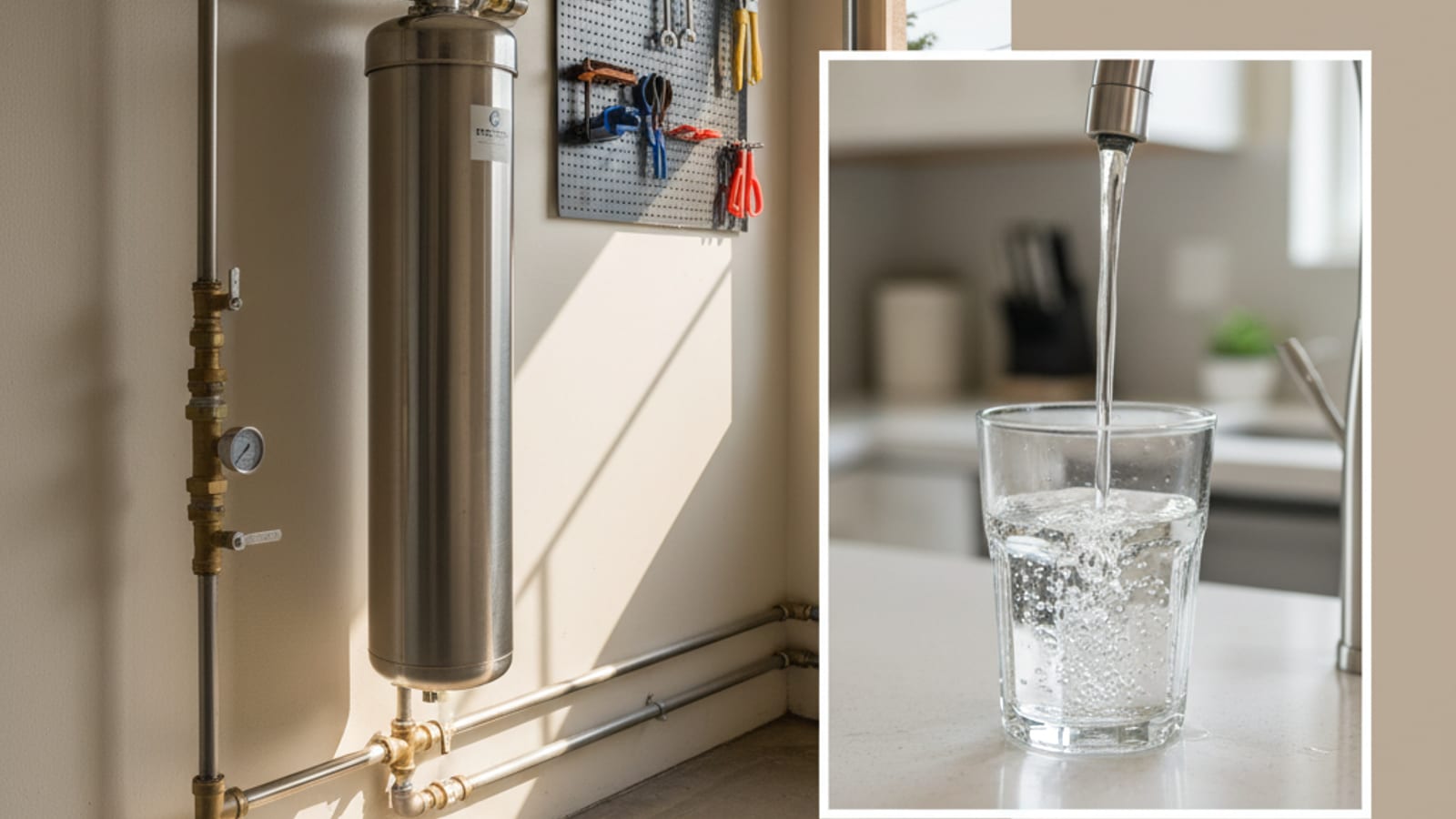
Most people assume that if there’s a chemical keeping their drinking water safe, it’s chlorine. For much of the country, that’s been true since the early twentieth century. But San Diego, along with many other large water systems, switched to a different disinfectant decades ago. If you’ve ever noticed that your tap water tastes or smells off even after running the tap, or if you keep fish or have a dialysis patient in your home, this distinction matters more than you might expect.
What chlorine does in drinking water
Chlorine has been added to public water supplies as a disinfectant since the early 1900s. It kills bacteria, viruses, and other pathogens that would otherwise make tap water unsafe to drink. Chlorine is effective and relatively inexpensive. For most of its history, it was the standard disinfectant for municipal water treatment.
The problem with chlorine as a sole disinfectant is that it dissipates. As treated water travels through miles of distribution pipes before reaching homes, the chlorine residual decreases. By the time water reaches customers far from the treatment plant, the disinfectant protection can be significantly reduced.
Chlorine also reacts with naturally occurring organic matter in water to form disinfection byproducts (DBPs), including trihalomethanes (THMs). THMs form when chlorine contacts humic acids and other organic material. The EPA regulates THMs in drinking water under the Total Trihalomethanes (TTHM) rule because long-term exposure at high levels has been associated with potential health effects in epidemiological studies.
What chloramine is and why utilities switched
Chloramine is formed by combining chlorine with a small amount of ammonia. The result is a compound called monochloramine, which is a less reactive but more stable disinfectant than free chlorine.
Water utilities, including those serving San Diego County, switched to chloramine for several practical reasons:
Stability in the distribution system. Chloramine persists longer in water as it travels through pipes. That means better disinfectant protection at the tap, especially for customers at the far end of a long distribution network.
Fewer THM formation reactions. Because chloramine is less reactive than free chlorine, it produces substantially lower levels of the trihalomethane disinfection byproducts that are regulated under EPA rules. Switching to chloramine helped many utilities come into compliance with the Stage 1 and Stage 2 Disinfectants and Disinfection Byproducts Rules.
The EPA regulates chloramine residuals in drinking water under the same framework as chlorine. The current maximum residual disinfectant level (MRDL) for chloramines is 4 mg/L, the same as for chlorine.
The practical differences you notice at home
Taste and smell. Chloramine has a different character than free chlorine. Some people describe the taste of chloraminated water as having a slight chemical or medicinal quality, sometimes described as “band-aid” or “pool-adjacent.” Others notice it less than free chlorine. Sensitivity varies considerably by individual. Either way, most people who want their drinking and cooking water to taste neutral find that some level of treatment is worthwhile.
It’s harder to remove. This is the critical point. Standard activated carbon filters, including pitcher filters and many basic under-sink cartridges, are designed primarily to reduce free chlorine. They do this well. Chloramine reduction requires significantly more from the filter media.
Free chlorine is broken down through a chemical reaction when it contacts activated carbon. Chloramine removal works through a different mechanism and at a much slower rate on standard carbon. The contact time required for effective chloramine reduction on conventional activated carbon is much longer than what most residential filter systems provide.
Catalytic carbon is different. Catalytic carbon is a modified form of activated carbon that has been treated to increase its surface reactivity. The catalytic surface accelerates the decomposition of chloramine significantly, making it practical to achieve effective chloramine reduction in a residential filter with normal flow rates and contact times. A system designed for San Diego water should use catalytic carbon media rather than standard activated carbon if chloramine removal is the goal.
At Filter Pros San Diego, our chlorine and chloramine removal systems use catalytic carbon media specifically because San Diego’s water supply requires it. A standard carbon block designed for a chlorinated system simply won’t perform the same way here.
Special concerns: fish tanks and dialysis
Aquarium fish. Chlorine and chloramine are both toxic to fish. Chlorine will off-gas from water over time if left standing, which is why aquarium hobbyists have historically been able to let tap water sit before adding it to a tank. Chloramine does not off-gas the same way. It remains stable in standing water. Fish tank owners in San Diego need to use a dechlorinator product specifically formulated to neutralize chloramine (look for products containing sodium thiosulfate plus an ammonia-neutralizing component), or use pre-filtered water. A whole-house filter with catalytic carbon will also address this at the source.
Dialysis patients. This is a medical safety concern, not just a comfort issue. Both chlorine and chloramine must be removed from water used in dialysis machines. Dialysis membranes are permeable to these compounds in a way that the gastrointestinal tract is not, meaning that dialysis patients are exposed at a much higher level than someone drinking the same water. Dialysis centers have treatment systems in place for this. Home dialysis patients should work with their care team and ensure their water treatment system is verified to remove chloramine, not just chlorine.
Homebrewing beer and other fermentation. Chloramine can affect fermentation and inhibit yeast activity, and it contributes off-flavors to beer that chlorine doesn’t. Homebrewers in San Diego have long needed to account for chloramine rather than just adding a Campden tablet, which neutralizes chlorine but not chloramine without the right chemistry. Catalytic carbon filtration before brewing resolves this without the need for chemical additions.
What a whole-house filter actually removes
A well-designed whole-house catalytic carbon filter will reduce chloramine throughout the home, not just at the kitchen tap. That means showers and baths, where chloramine can be inhaled as steam or absorbed through skin, are also addressed. It means the water going into your ice maker, coffee maker, and washing machine has been treated.
For drinking and cooking specifically, a dedicated under-sink system with catalytic carbon or a combination of catalytic carbon and other media stages provides the most consistent point-of-use treatment. Some households use both whole-house filtration for general protection and an under-sink system for drinking water quality.
Knowing what’s in your specific tap water
San Diego’s water blend varies by season and by location within the county, because different distribution zones receive different proportions of Colorado River water and State Water Project water, and the two sources have somewhat different chemistry. The City of San Diego’s Public Utilities department publishes annual water quality reports, but a home water test gives you a measurement at your actual tap rather than a system-wide average.
We offer a free in-home water test that measures chloramine levels along with hardness, pH, total dissolved solids, and other key parameters. That data lets us recommend the right treatment for your actual water rather than a generic solution.
Call us at (858) 925-5546 or schedule your test online. We serve homeowners throughout San Diego County.
Related: Chlorine and chloramine removal systems | Whole-house water filtration