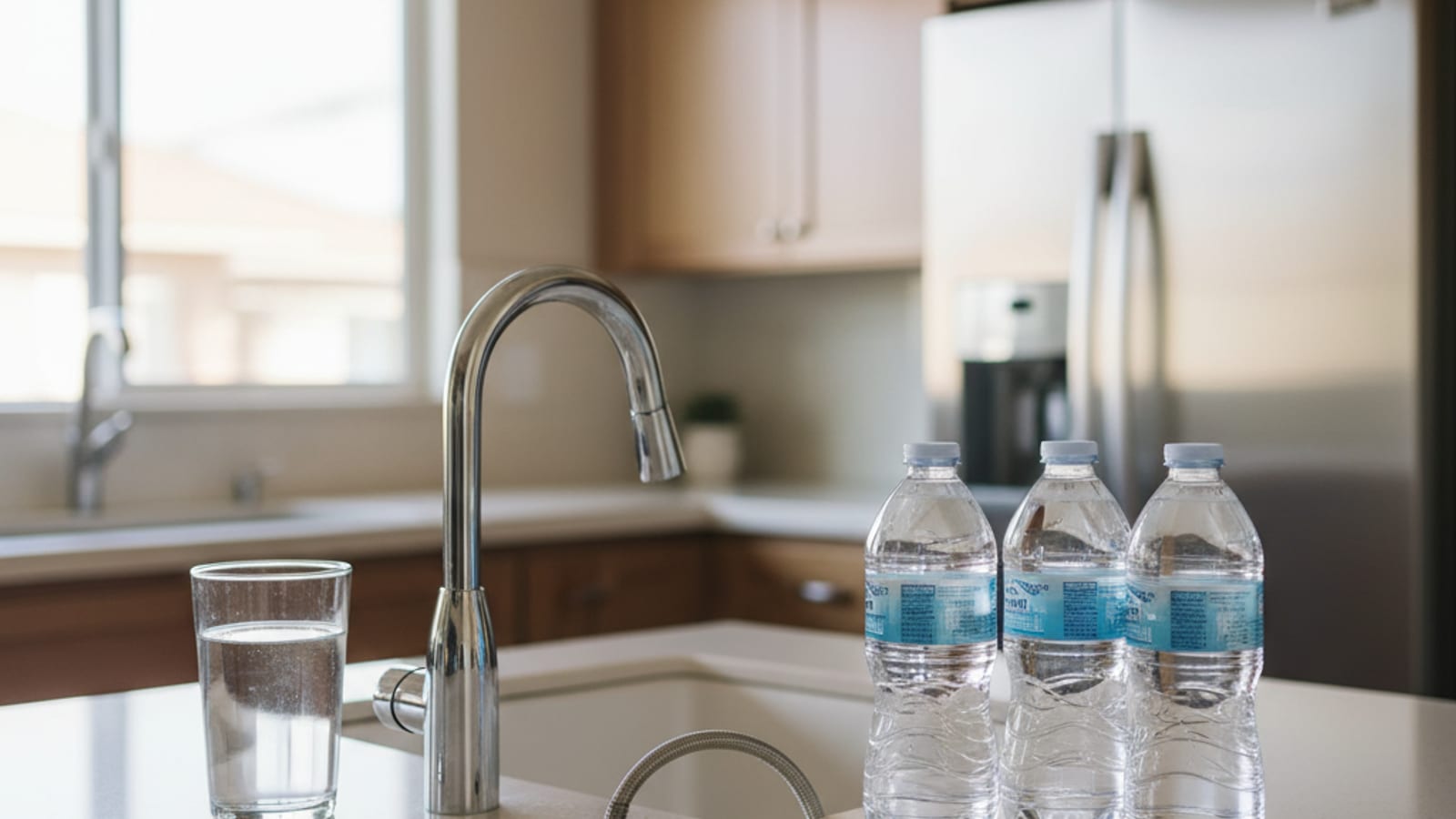
Bottled water is a massive industry. Americans drink more bottled water per capita than any other packaged beverage, and the market has grown steadily for two decades. The implicit promise is that bottled water is cleaner, purer, or somehow better than what comes out of the tap.
When you compare it directly to filtered water produced by a home reverse osmosis system, the picture looks quite different.
How bottled water is regulated
Bottled water sold in the United States is regulated by the FDA, not the EPA. Tap water delivered by municipal utilities is regulated by the EPA under the Safe Drinking Water Act. This matters because the two regulatory regimes are not equivalent.
The EPA requires municipal water utilities to test continuously, test frequently, and publish annual consumer confidence reports disclosing exactly what was found in the water. If a contaminant exceeds a maximum contaminant level, utilities must notify customers.
The FDA regulates bottled water as a packaged food product. Testing requirements are less frequent, and results are not subject to the same public disclosure requirements. The Natural Resources Defense Council conducted an extensive review of the bottled water industry and found that about 25 percent of bottled water is simply reprocessed tap water (often labeled as “purified water” or “drinking water”), and that FDA regulations are weaker than EPA tap water standards in some areas.
This doesn’t mean bottled water is unsafe. Most of it meets reasonable quality standards. It means the assumption that bottled water is held to a higher standard than tap is not accurate.
What reverse osmosis filtered water actually does
A reverse osmosis system forces water through a semi-permeable membrane with pores small enough to block dissolved contaminants. The process removes lead, nitrates, arsenic, chromium-6, fluoride, chloramines, chlorine, pharmaceuticals, certain PFAS compounds, dissolved solids, and most other contaminants that are present in municipal source water.
The EPA and NSF International both maintain standards for reverse osmosis performance. NSF/ANSI Standard 58 is the benchmark for residential RO systems, covering contaminant reduction claims and materials safety.
The water produced by a quality RO system is filtered more thoroughly than most bottled water. High-end bottled water brands do use RO and additional treatment stages, but so do mid-range home systems. The difference is that the home system filters continuously from your existing tap water, at a fraction of the per-gallon cost.
The cost math
Bottled water costs vary widely by brand and format, but across the market, consumers typically pay somewhere between $0.50 and $3.00 per gallon for name-brand water, and somewhat less for store-brand options bought in bulk. Over a year, a household that drinks primarily bottled water can easily spend several hundred dollars or significantly more depending on consumption.
A home reverse osmosis system under the kitchen sink typically filters water for a few cents per gallon once the system cost is amortized over its lifespan. Filter replacement costs are the ongoing expense, and they’re predictable. The math heavily favors filtered water over any multi-year time horizon, without inventing specific figures that depend on variables like local water cost and individual consumption.
The payback period for a quality RO system, compared to regular bottled water purchases, is typically measured in months, not years.
Microplastics: a concern that has shifted the conversation
For a long time, the main argument for bottled water was simple convenience and taste. In recent years, microplastics research has complicated that argument significantly.
A 2018 study by researchers at the State University of New York at Fredonia, commissioned by Orb Media, analyzed 259 bottled water samples from 11 brands across nine countries. Microplastic contamination was detected in 93 percent of samples. The WHO subsequently reviewed the evidence and concluded that microplastics in drinking water are a concern that warrants further research.
Bottled water plastic doesn’t just appear in the product when you drink it. Plastics leach compounds into water over time, particularly when stored in warm conditions or exposed to sunlight. Antimony, a chemical used in PET plastic production, can migrate into water stored in PET bottles over time, according to research published in the journal Environmental Pollution.
Reverse osmosis filtration removes microplastics. The membrane pore size is far smaller than the size of microplastic particles typically found in source water. Home RO systems effectively address the microplastic concern that bottled water creates through its packaging.
Convenience and what it actually costs
Bottled water wins on one dimension: you can grab it anywhere. That’s a real advantage for on-the-go hydration.
For home drinking water, the convenience calculation reverses. You don’t carry home cases of plastic bottles. You don’t run out on a Sunday night. You don’t store pallet-loads of water somewhere in the house. You turn on the faucet at the RO tap under the kitchen sink and fill a glass or a reusable bottle.
Many people who install home RO systems also buy a good reusable stainless bottle and fill it from the RO tap before leaving the house. This captures the convenience of bottled water away from home while eliminating the recurring cost and plastic waste.
What filtered water tastes like
San Diego tap water has a noticeable taste that most residents are aware of. Chloramine treatment, high mineral content, and other dissolved solids all contribute to the flavor. Some people adapt to it. Others find it off-putting enough to default to bottled water.
Reverse osmosis removes the chloramines, minerals, and dissolved solids that create that flavor. RO water tastes clean and neutral. For most people, it tastes noticeably better than unfiltered tap water and comparably to or better than mid-range bottled water.
The difference between San Diego tap and well-filtered RO water is one of the first things people comment on after installation.
Environmental perspective
Recycling rates for PET plastic bottles in the United States are well below 50 percent, meaning the majority of single-use water bottles end up in landfills or the environment. Producing plastic bottles also requires petroleum as a feedstock.
A home RO system produces some wastewater in the filtration process, which is a legitimate tradeoff to acknowledge. But across a year of use, the environmental footprint of one home RO system is substantially lower than the same household buying an equivalent volume of bottled water.
When bottled water makes sense
Away from home and without access to a filtered source, bottled water makes obvious sense. In areas with acute water quality emergencies where tap water is unsafe, bottled water serves an important safety function.
As a permanent home drinking water strategy, it doesn’t hold up against the combination of quality, cost, and sustainability that home filtration offers.
Filtered water at home
Our reverse osmosis drinking water systems install under the kitchen sink with a dedicated tap. They work alongside a whole-house system or independently as a standalone drinking water solution.
If you want to know what’s actually in your tap water before deciding what kind of filtration you need, a free in-home water test is the right starting point. We’ll test what’s there and walk you through what treatment makes sense.
Call (858) 925-5546 to get started.
Related reading: