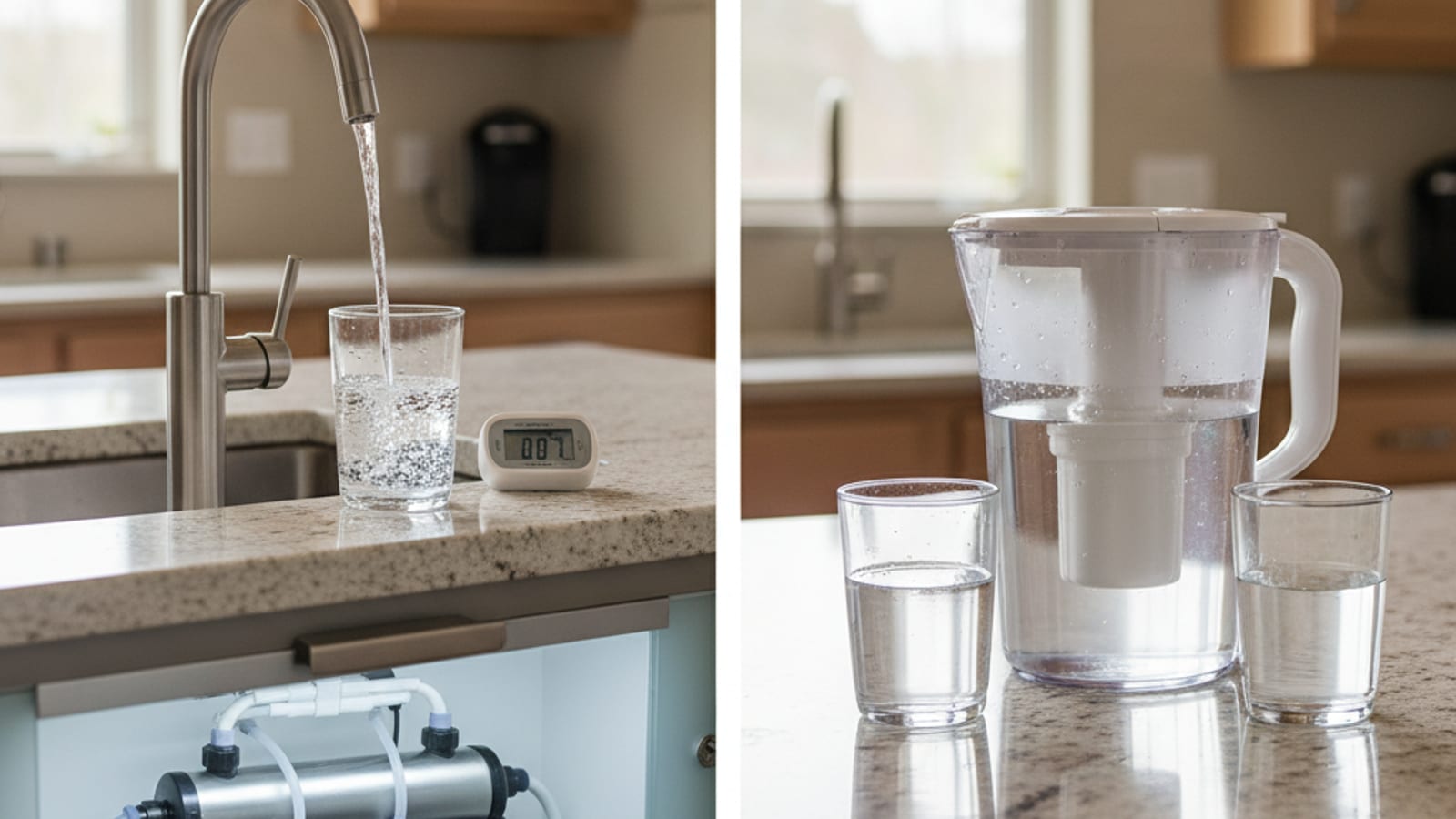
A lot of San Diego households use a filter pitcher on the counter. They’re familiar, they’re inexpensive to start, and they do make tap water taste better. But if your goal is to remove a broad range of contaminants, including the ones San Diego water actually contains at measurable levels, a pitcher isn’t built for that job. This is a direct comparison of how each system works, what each one actually removes, and when it makes sense to use one versus the other.
How a filter pitcher works
A pitcher filter typically contains a cartridge filled with activated carbon, often granular activated carbon (GAC) or a compressed carbon block. Some pitchers add an ion-exchange resin to the carbon stage to further reduce certain minerals and metals.
Water pours slowly through the cartridge by gravity. Contact with the carbon surface reduces free chlorine and the taste and odor compounds associated with it. Some longer-chain organic compounds are also partially adsorbed onto the carbon.
The limitations are built into the design. Gravity flow means short contact time with the media, which limits what the filter can address. The pore size in a carbon cartridge cannot filter dissolved inorganic compounds, dissolved minerals, nitrates, fluoride, or PFAS. The small cartridges in pitchers are not certified to reduce PFAS compounds. Standard activated carbon also does not reliably remove chloramine, which is what San Diego water uses as its disinfectant rather than free chlorine.
Pitcher filters also have a hidden cost structure. The initial pitcher price is low, often $25 to $50, but filter cartridge replacements run $8 to $20 each and are typically rated for about 40 gallons. A household drinking two gallons per day will go through a cartridge roughly every three weeks. Annual filter cost runs $125 to $250 per year for one pitcher, not counting the plastic cartridge waste.
How reverse osmosis works
A multi-stage under-sink reverse osmosis (RO) system works through a fundamentally different mechanism. Water is pushed under pressure through a semi-permeable membrane with pores small enough to block dissolved contaminants. This process, osmosis in reverse, is capable of removing contaminants that are far too small to be captured by any carbon filter.
A typical residential RO system includes three to five stages:
- Sediment pre-filter: removes particulates that could foul the membrane
- Carbon pre-filter: reduces chlorine or chloramine before the membrane (membrane life is shortened by oxidant exposure)
- RO membrane: the primary reduction stage for dissolved contaminants
- Post-filter/polishing carbon: final taste and odor improvement
- Storage tank: holds filtered water ready for use at the dedicated faucet
The RO membrane removes dissolved solids by rejecting them based on size and charge. Typical residential membranes achieve 90 to 99% rejection of many dissolved compounds under normal operating conditions.
What each system removes (and doesn’t)
This is where the two systems diverge significantly.
Filter pitcher (activated carbon):
- Reduces: free chlorine, taste and odor compounds, some volatile organic compounds (VOCs), some partial chloramine reduction in high-quality media
- Does not remove: dissolved minerals (hardness), total dissolved solids (TDS), PFAS, nitrates, fluoride, arsenic, heavy metals in solution, chloramine reliably
Reverse osmosis (multi-stage):
- Reduces: PFAS (when certified to NSF/ANSI 58 Protocol P473), dissolved solids (TDS), nitrates, fluoride, arsenic, heavy metals including lead, chloramine (with catalytic carbon pre-filter), many industrial contaminants, total dissolved solids typically reduced 85-98%
- Does not remove: some dissolved gases (though carbon post-filtration addresses taste)
For San Diego specifically, this matters because the water is high in total dissolved solids from the Colorado River source, uses chloramine rather than chlorine as the disinfectant, and has PFAS compounds present (though at low levels). A pitcher filter addresses the taste symptom without addressing the underlying water chemistry.
Third-party certification: what to look for
Both categories have certification standards that matter when comparing products.
For pitchers, NSF/ANSI 42 covers aesthetic effects (taste and odor), and NSF/ANSI 53 covers health effects claims for certain contaminants. Few pitchers carry broad NSF 53 certification.
For RO systems, NSF/ANSI 58 is the relevant standard. RO systems certified to this standard have been tested and verified to perform the reduction claims on the label. For PFAS reduction specifically, look for certification to NSF/ANSI 58 Protocol P473, which tests for PFOA and PFOS reduction. NSF International maintains the full certification database for verifying product claims. This is not the same as a general NSF 58 certification, so check the specific PFAS testing addendum.
Cost comparison over five years
Filter pitcher:
- Upfront cost: $35 (mid-range pitcher)
- Annual cartridge replacement: $150 to $200
- 5-year total: approximately $785 to $1,035
Under-sink RO system:
- Upfront cost: $300 to $800 installed (varies by system quality and installation)
- Annual filter/membrane maintenance: $60 to $120 (pre/post filters annually, membrane every 2 to 3 years)
- 5-year total: approximately $600 to $1,400 installed
The two categories overlap significantly in five-year cost. A mid-quality RO system professionally installed pays for itself over a pitcher filter in roughly 3 to 4 years when you account for ongoing cartridge costs, and it provides substantially broader contaminant reduction throughout that period.
Convenience and daily use
A pitcher filter requires manual filling. A two-liter pitcher needs to be refilled multiple times per day in a household with normal water consumption. The flow rate through gravity filtration is slow, meaning you’re waiting for the filter to drain between pours.
An under-sink RO system installs once and delivers filtered water on demand at a dedicated faucet. There’s no manual filling, no waiting. The storage tank holds enough filtered water for typical drinking and cooking use. Maintenance is annual or less frequent for the membrane.
The tradeoff is that an RO system requires under-sink space, produces a small amount of waste water during the filtration process (the concentrate stream that flushes rejected contaminants down the drain), and needs professional installation to ensure proper connection to the supply line and drain. High-efficiency modern membranes have improved the waste water ratio considerably compared to older systems.
When a pitcher filter makes sense
A filter pitcher is a reasonable choice when your primary goal is taste and odor improvement in a rental where you can’t install under-sink equipment, when budget constraints make any upfront installation cost impractical right now, or as a temporary solution while you evaluate permanent options.
It’s not the right tool if you’re specifically concerned about PFAS, lead, nitrates, fluoride, or overall total dissolved solids. For those goals, you need an RO system or another treatment technology rated for those specific contaminants.
When RO makes sense
An under-sink RO system makes sense for most San Diego homeowners who want their drinking and cooking water to be reliably clean across a broad range of contaminants. It’s especially relevant if you have children or immunocompromised household members, if you’re concerned about PFAS, if your home has older plumbing that may contribute lead, or if you simply want certainty about what’s in the water you drink every day.
The right system matters as much as the category. A budget RO unit with a plastic-lined tank trades one concern for another. Our reverse osmosis drinking water systems use medical-grade stainless steel pressure tanks rather than plastic-lined vessels, because the tank the water sits in between uses matters for what ends up in the glass.
Start with knowing what’s in your water
Before buying anything, know what your actual tap water contains. A general sense that “San Diego water is hard and uses chloramine” is a starting point, but it doesn’t tell you your specific TDS, actual hardness, lead levels at your tap, or trace contaminant levels in your supply zone.
We offer a free in-home water test that measures the parameters that matter for treatment decisions. It takes about an hour and gives you real numbers from your actual faucet, not a county average.
Call us at (858) 925-5546 to schedule. We serve homeowners throughout San Diego County.
Related: Reverse osmosis drinking water systems | PFAS removal for San Diego homes