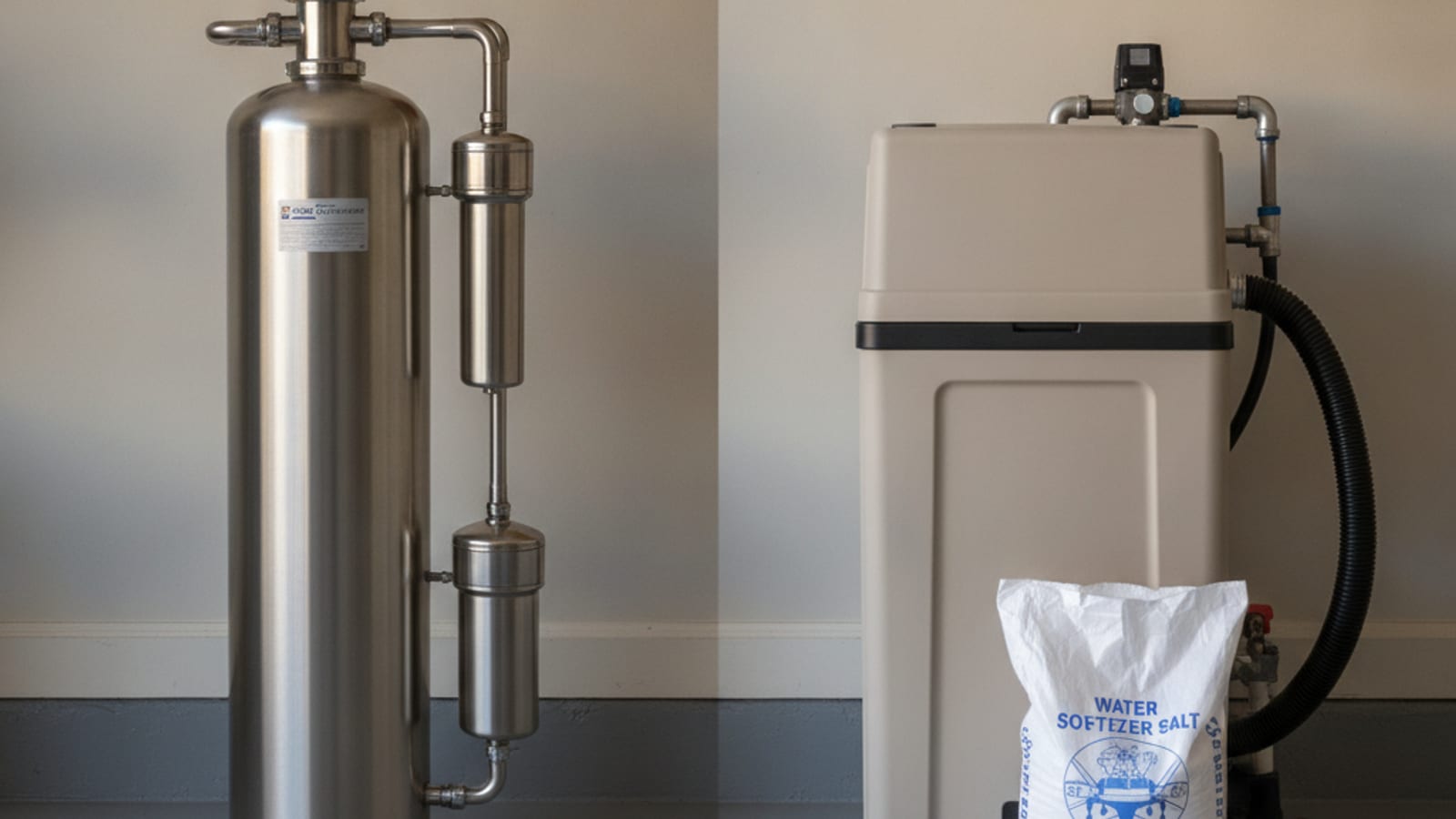
San Diego water is genuinely, measurably hard. At 17 to 20+ grains per gallon, it’s in the top tier of hardness in the United States. That’s why scale builds up on your showerheads, glassware comes out of the dishwasher spotted, and water heaters lose efficiency faster than they should.
The two main options for dealing with it are a traditional ion-exchange water softener and a salt-free water conditioner. They work completely differently, have different tradeoffs, and the right choice depends on your household.
Here’s what you actually need to know.
How a traditional water softener works
Ion-exchange softeners replace calcium and magnesium ions (the minerals that cause hardness) with sodium ions. Water flows through a tank of resin beads that have sodium attached to them. Calcium and magnesium stick to the beads; sodium goes into your water instead.
The result is genuinely soft water. The slippery feel in the shower is real, and it’s because soap lathers more fully and rinses cleanly without mineral residue. Scale stops forming entirely. Appliances last longer. Skin and hair often feel different.
The system regenerates on a schedule, flushing the resin with a brine solution (salt dissolved in water) to recharge the beads and discharge the mineral-heavy wastewater down the drain.
What that means practically
You’re buying bags of salt and loading them into the brine tank, typically every few weeks to every few months depending on your water use and system size. The system adds a small amount of sodium to your water, which is worth knowing if you’re on a low-sodium diet or if you have a doctor’s recommendation to limit sodium intake. Most softened water contains amounts in the range of other common food sources, but it’s a real consideration.
The brine discharge is the bigger issue in California.
California salt restrictions
California has been regulating salt discharge from water softeners for years. Several water agencies in San Diego County restrict or prohibit the discharge of softener brine into the sewer system because of the impact on recycled water quality and groundwater, a policy area overseen by the California State Water Resources Control Board’s Division of Drinking Water. The list of restricted areas has grown.
Before installing a traditional salt-based softener in San Diego, it’s worth confirming whether your specific city or water district has restrictions. Some allow it with limitations on regeneration frequency; others prohibit it outright for new installations.
This regulatory environment is part of why salt-free systems have become the default recommendation for many San Diego homes.
How a salt-free water conditioner works
Salt-free systems don’t remove calcium and magnesium from the water. Instead, they change the form of those minerals so they’re less likely to stick to surfaces and form scale.
The technology used in the PF1025 system is template-assisted crystallization (TAC). Water passes through a media that triggers calcium and magnesium to form microscopic crystals that stay suspended in the water rather than depositing on pipes, fixtures, and heating elements. The hardness minerals are still there, but they pass through without building up.
There’s no salt. No sodium is added to your water. No brine tank to maintain. No bags to buy or carry. No discharge. The system is essentially maintenance-free once installed.
What you’ll notice (and what you won’t)
Water conditioned with TAC technology won’t feel slippery in the shower. That’s the most common thing people expect and don’t experience. The water isn’t softened in the traditional sense. It’s conditioned.
What you will notice over time: scale stops accumulating. Existing light scale gradually softens and clears from fixtures. Your water heater, dishwasher, and appliances maintain efficiency. Your pipes don’t clog with mineral deposits.
The taste of the water stays the same. You’re not adding or removing anything. For drinking water quality, you’d pair a conditioner with a reverse osmosis drinking water system under the sink, which is a separate conversation.
Comparing them directly
| Ion-exchange softener | Salt-free PF1025 conditioner | |
|---|---|---|
| Removes hardness minerals | Yes | No |
| Prevents scale buildup | Yes | Yes |
| Salt/sodium added | Yes | No |
| Ongoing maintenance | Salt bags, periodic service | Minimal |
| Brine discharge | Yes | No |
| California restrictions | Possible | None |
| Septic compatible | Limited | Yes |
| Slippery feel in shower | Yes | No |
Septic systems
If your home is on a septic system, a traditional softener creates real problems. The brine discharge and the increased sodium load can disrupt the bacterial balance in the septic tank and potentially damage the drain field. Most septic system professionals recommend against traditional softeners.
A salt-free conditioner has none of these concerns. It adds nothing to your water, so there’s nothing unusual going into the septic system.
Which one is right for your household
A traditional ion-exchange softener might be the better fit if you have very specific needs around skin conditions, very old plumbing with aggressive scaling, or you’re in an area without discharge restrictions. Some people simply prefer the feel of classically softened water.
A salt-free PF1025 conditioner is typically the better fit for most San Diego homes, for a few reasons. There’s no ongoing cost for salt. No brine discharge to worry about. No restrictions from your water district. No sodium in your water. No maintenance. And it handles San Diego’s hard water without the tradeoffs.
For households on a septic system, the conditioner isn’t just preferred, it’s the practical choice.
The tank question
One more factor worth mentioning. Water treatment systems use tanks made of different materials. Fiberglass tanks are common and cost-effective, but they typically have a plastic liner that contacts your water over the life of the system. Medical-grade stainless steel tanks don’t have that liner. If tank material matters to you, it’s worth asking what your system is made of.
Filter Pros San Diego uses medical-grade stainless steel tanks. It’s a difference in build quality that we think matters for a system you’re putting in your home for the next 10 to 15 years.
Not sure which way to go?
The honest answer is that the right system depends on your water, your plumbing, your household, and your local discharge rules. A free in-home water test gives you the actual hardness reading from your taps and a clear picture of what you’re working with.
From there, the choice is straightforward.
Schedule your free in-home water test or call us at (858) 925-5546. We can walk you through salt-free water conditioning and hard water solutions based on what your water actually shows.