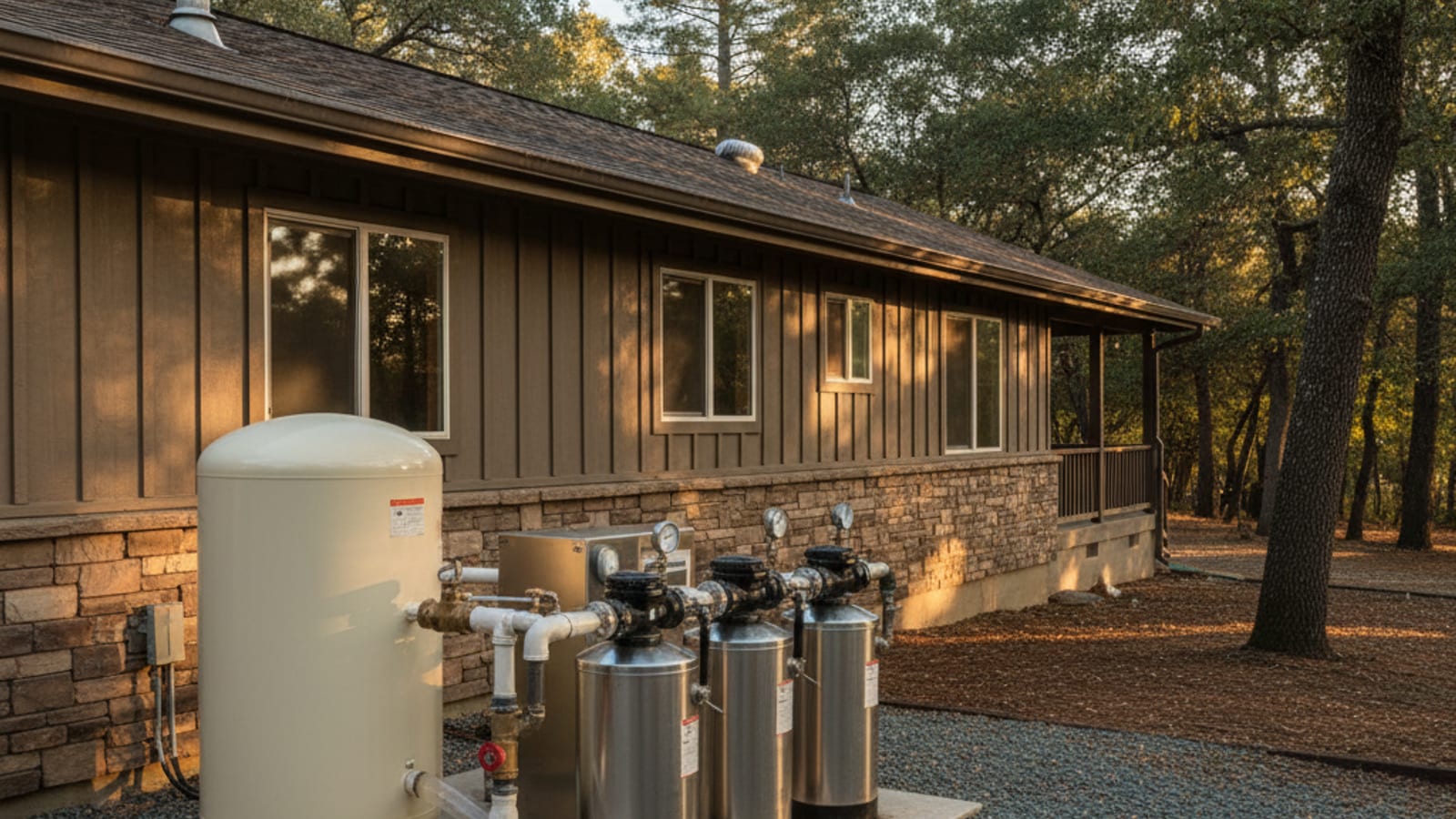
If your home sits on a few acres in Ramona, Julian, Alpine, Fallbrook, Valley Center, or anywhere in the San Diego backcountry, there’s a good chance your water doesn’t come from a municipal system. You’re on a private well. That means everything that ends up in your water supply is entirely your responsibility to monitor and treat.
That’s not a scare tactic. It’s just the reality of well ownership. The good news is that well water problems in San Diego County are well understood, consistently testable, and very treatable once you know what you’re dealing with.
Why well water is different from city water
Municipal water systems are regulated under the Safe Drinking Water Act. The EPA sets maximum contaminant levels, and water utilities test constantly and treat before the water reaches your tap. Private well water has no such oversight. The County of San Diego and state guidelines recommend annual testing, but no agency is checking your well for you.
That matters because the contaminants in well water are often nothing like what city water contains. Instead of chlorine and chloramines added by utilities, well water carries naturally occurring minerals, dissolved gases, sediment, and sometimes bacteria from the surrounding geology and land use. San Diego’s inland and mountain zones have their own set of common issues.
The most common well water problems in San Diego County
Iron staining
Iron is one of the most widespread complaints from San Diego well owners. Water with elevated iron looks clear coming out of the tap, then leaves orange or rust-colored stains on fixtures, toilets, sinks, and laundry. Even relatively low levels, around 0.3 mg/L and above (the EPA’s secondary standard), are enough to cause visible staining. In some backcountry wells, concentrations run significantly higher.
Iron in well water comes in two forms. Ferrous iron is dissolved and invisible in water. Ferric iron is already oxidized and appears as particles you can see. Most treatment approaches need to address both.
Sulfur smell (hydrogen sulfide)
If your water has a rotten-egg or sulfur odor, the culprit is almost certainly hydrogen sulfide gas. It’s naturally produced by certain bacteria and by geochemical processes in groundwater. It’s more common in wells drilled into sedimentary rock formations, which are found throughout the foothills and mountain areas of San Diego County.
At the concentrations typically found in residential wells, hydrogen sulfide is primarily an aesthetic problem, though it can also accelerate corrosion in pipes and appliances. The EPA notes that even very low concentrations, below 1 part per million, are detectable by smell.
Sediment and turbidity
Older wells, wells in sandy soils, and wells after heavy rainfall can pull in fine sediment, sand, or silt. Sediment clogs fixtures, wears out appliances, and creates downstream problems if not addressed at the point of entry. It’s the easiest issue to treat, but also the one most often skipped because people assume it’s harmless.
Hardness
San Diego County water in general trends hard. Inland and mountain well water often runs even harder than city water in coastal areas, commonly in the 17 to 25+ grains per gallon range depending on the specific geology. Hard water causes scale buildup in pipes, water heaters, and appliances. It makes soap and shampoo less effective. Over time, it shortens the lifespan of water-using equipment.
Low pH and corrosivity
Some mountain and foothill wells in San Diego produce slightly acidic water, with pH values below 7.0. Acidic water is corrosive. It leaches copper and lead from plumbing, which creates a health concern on top of the metallic taste and blue-green staining it leaves on fixtures. This is particularly worth testing for in homes with older copper piping.
Bacteria
The California State Water Resources Control Board’s Division of Drinking Water notes that private wells can be susceptible to contamination from surface water intrusion, especially near livestock operations, septic systems, or agricultural land. Total coliform bacteria and E. coli are the standard screening tests. Most rural San Diego County areas have low baseline bacterial contamination, but the risk is real and testing is the only way to know.
Always test before you treat
This is the most important thing to understand about well water treatment: you cannot build a treatment system without knowing what’s actually in your water. The right system for iron and sulfur is different from the right system for bacteria and low pH. Installing the wrong treatment wastes money and can make some problems worse.
A comprehensive well water test should include hardness, pH, iron (total and ferrous), manganese, hydrogen sulfide, nitrates, coliform bacteria, and total dissolved solids at minimum. Depending on your location, testing for arsenic and other naturally occurring minerals may also be appropriate. San Diego County has isolated areas with elevated naturally occurring arsenic, particularly in some areas of the backcountry.
A free in-home water test is the starting point. It gives you real data before any equipment decision gets made.
How well water treatment systems are typically structured
Effective well water treatment usually involves a sequence of stages, each addressing a different problem. The order matters.
Stage 1: Sediment pre-filter
Every well treatment system starts with a sediment filter. This protects all downstream equipment from particles that would otherwise clog media, foul membranes, or damage UV lamps. A whole-house sediment filter with a fine enough micron rating catches sand, silt, and rust particles before they reach anything else.
Stage 2: Iron and sulfur treatment
For most San Diego County well owners dealing with staining or odor, this is the centerpiece of the system. Air injection oxidation systems, greensand filters, and catalytic carbon filters are the most common approaches. The right choice depends on the iron concentration, whether manganese is also present, and the water’s pH. A properly sized iron/sulfur system can eliminate both staining and odor entirely.
Stage 3: Acid neutralizer (if pH is low)
If your water tests acidic, an acid neutralizer tank filled with calcite or a calcite/magnesium oxide blend raises pH to a neutral range. This stops corrosion, protects copper pipes, and prevents blue-green staining. It’s a simple passive system that backwashes itself on a timer.
Stage 4: UV disinfection
Ultraviolet treatment is the standard approach for bacteria in residential well water. UV light kills bacteria, viruses, and other pathogens without adding chemicals. It has no effect on taste or odor. EPA guidelines and NSF/ANSI Standard 55, maintained by NSF International, cover UV disinfection performance requirements. UV is the final stage of the treatment train because the water needs to be clear (low turbidity, low iron) for UV to work effectively. That’s why it comes after the upstream filtration stages.
Stage 5: Softening or salt-free conditioning
If hardness is a significant issue, a softener or salt-free conditioner handles it downstream of the other treatment stages. Traditional salt-based softeners exchange calcium and magnesium for sodium. Salt-free systems like our PF1025 condition the water using template-assisted crystallization, which transforms hardness minerals into a form that doesn’t scale, with no salt, no sodium, and no brine to discharge. For well owners already managing water quality carefully, the salt-free approach avoids adding sodium back to treated water.
For drinking water specifically, a reverse osmosis system at the kitchen sink provides an additional layer of purification beyond what a whole-house system delivers.
The equipment itself matters
One thing that matters with any well treatment system is how the tanks and vessels are made. Treatment equipment works under pressure and constant contact with minerals, iron, and varying pH water. Fiberglass tanks with plastic liners, common in discount and big-box systems, can degrade over time when exposed to iron, low pH, or chlorine compounds used for shock treatment. Medical-grade stainless steel tanks hold up under those conditions without the liner concerns that come with fiberglass construction.
Getting started
Well water treatment in San Diego County doesn’t have to be complicated. Start with a test. Understand what’s actually in your water. Then build a system that addresses your specific problems in the right order.
If you’re in Ramona, Julian, Alpine, Fallbrook, Valley Center, or elsewhere in the backcountry, call (858) 925-5546 or schedule a free in-home water test to get a clear picture of what your well is producing.
Related reading: